

In the name of Allah, Most Merciful, the Bestower of Mercy.
I have made this article freely available. I request that you donate a small amount to the “Salafi Bookstore and Islamic Centre” so they can continue their work of printing and distributing free audios, leaflets, and booklets to aid the da’wah of Ahlus-Sunnah and Hadīth across the world.
All praise is due to Allāh, Lord of the worlds. May the peace, blessings and salutations of Allāh be upon our noble Messenger, Muhammad, and upon his family, his Companions and his true followers.
Accept the truth when you hear it, for indeed upon the truth there is a light.
Yazeed Ibn ʿAmeerah (rahimahullāh) narrated that the Companion of Allah’s Messenger (salallāhu ʿalaihi wasallam), Muʿādh Ibn Jabal (radiyallāhu ʿanhu) said:
إِنَّ مِنْ وَرَائِكُمْ فِتَنًا يَكْثُرُ فِيهَا الْمَالُ وَيُفْتَحُ فِيهَا الْقُرْآنُ حَتَّى يَأْخُذَهُ الْمُؤْمِنُ وَالْمُنَافِقُ وَالرَّجُلُ وَالْمَرْأَةُ وَالصَّغِيرُ وَالْكَبِيرُ وَالْعَبْدُ وَالْحُرُّ فَيُوشِكُ قَائِلٌ أَنْ يَقُولَ مَا لِلنَّاسِ لاَ يَتَّبِعُونِي وَقَدْ قَرَأْتُ الْقُرْآنَ مَا هُمْ بِمُتَّبِعِيَّ حَتَّى أَبْتَدِعَ لَهُمْ غَيْرَهُ فَإِيَّاكُمْ وَمَا ابْتُدِعَ فَإِنَّ مَا ابْتُدِعَ ضَلاَلَةٌ وَأُحَذِّرُكُمْ زَيْغَةَ الْحَكِيمِ فَإِنَّ الشَّيْطَانَ قَدْ يَقُولُ كَلِمَةَ الضَّلاَلَةِ عَلَى لِسَانِ الْحَكِيمِ وَقَدْ يَقُولُ الْمُنَافِقُ كَلِمَةَ الْحَقِّ . قَالَ قُلْتُ لِمُعَاذٍ مَا يُدْرِينِي رَحِمَكَ اللَّهُ أَنَّ الْحَكِيمَ قَدْ يَقُولُ كَلِمَةَ الضَّلاَلَةِ وَأَنَّ الْمُنَافِقَ قَدْ يَقُولُ كَلِمَةَ الْحَقِّ قَالَ بَلَى اجْتَنِبْ مِنْ كَلاَمِ الْحَكِيمِ الْمُشْتَهِرَاتِ الَّتِي يُقَالُ لَهَا مَا هَذِهِ وَلاَ يُثْنِيَنَّكَ ذَلِكَ عَنْهُ فَإِنَّهُ لَعَلَّهُ أَنْ يُرَاجِعَ وَتَلَقَّ الْحَقَّ إِذَا سَمِعْتَهُ فَإِنَّ عَلَى الْحَقِّ نُورًا
“Surely, ahead of you are trials (fitan) wherein wealth will become plentiful, and the Qur’ān will be widely opened and recited — such that the believer will take it, the hypocrite will take it, the man and the woman, the young and the old, the slave and the free.
Then it will soon be that a person will say: “Why is it that the people do not follow me, when I have recited [to them] the Qur’ān? They will not follow me until I introduce for them something other than it.”
So beware of what is newly introduced, for indeed whatever is newly introduced is misguidance.
And I warn you against the slip of the wise man, for indeed Shaytān may speak a word of misguidance upon the tongue of a wise man. And the hypocrite may at times speak a word of truth!”
I said to Muʿādh, “How shall I know — may Allāh have mercy upon you — that the wise man has spoken a word of misguidance, and that the hypocrite has spoken a word of truth?”
He replied: “Yes, avoid the wise man’s words that become well known, and it is said about them, ‘What are these [words]?’ Yet do not let that cause you to abandon him altogether, because he may retract it. And accept the truth when you hear it, for indeed upon the truth there is a light.” (Sunan Abī Dawud, no. 4611, graded saheeh by al-Albānī as a statement of Muʿādh Ibn Jabal)
Shaikhul-Islam Ibn Taymiyyah (rahimahullāh) said:
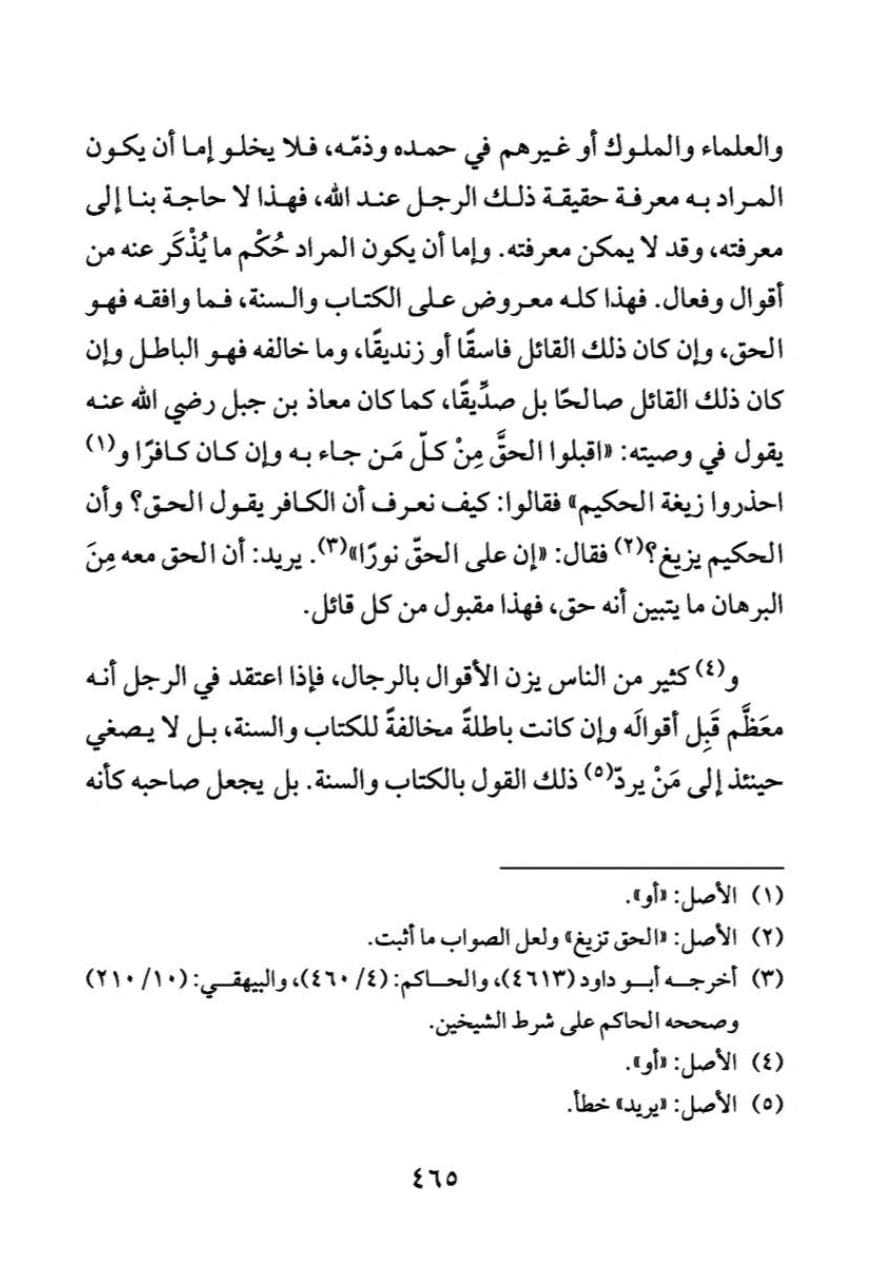
“He intends: The truth is accompanied by clear proof by which it is known to be the truth — so it is accepted from whoever speaks it. Yet many people weigh statements by men [who speak with them]. So if a person holds a man to be great and venerable, he accepts his sayings — even if they are false and in opposition to the Book and the Sunnah. Rather, he will not even listen to the one who refutes that statement with the Book and the Sunnah. Instead, he treats him (the ones he holds to be great) as though he were infallible.
And if he believes a man to be of no standing, he rejects his statements — even if they are true! Thus, he makes the speaker himself the cause for acceptance or rejection, without weighing the matter against the Book and the Sunnah.” (See Jāmiʿ al-Masā’il li Shaikhil-Islam Ibn Taymiyyah, pp. 465-466)


Al-Imām Ibn al-Qayyim (rahimahullāh) said:
فمن هداه اللهُ سُبحانَه إلى الأخذِ بالحقِّ حيثُ كان، ومع مَن كان، ولو كان مع من يُبغِضُه ويُعاديه، وردِّ الباطِلِ مع من كان، ولو كان مع مَن يحِبُّه ويُواليه؛ فهو ممَّن هُدِيَ لِما اختُلِفَ فيه من الحَقِّ
“So whoever Allāh (the Exalted and Perfect) guides to accepting the truth wherever it may be found, and with whomever it may be—even if it be with one whom he dislikes and opposes—and [whoever Allah guides] to rejecting falsehood with whomever it may be, even if it be with one whom he loves and allies himself with, then he is from those who have been guided to the truth concerning that over which the people differ.” (As-Sawā’iq al-Mursalah, 2/516)
Shaikhul-Islām Ibn Bāz (rahimahullāh) said:
“Whoever makes a mistake, then he is not taken from in his mistake, and the mistake is rejected just as Imām Mālik (rahimahullāh) said: ‘There is not one of us except that his speech is accepted or rejected except for the companion of this grave,’ meaning the Prophet (salallāhu ʿalaihi wasallam). Every scholar can be correct or mistaken. So, his correct views are taken, and his mistakes are left.” He continued: “That applies to all the great scholars if they make a mistake: ash-Shāfiʿī, Abū Hanīfah, Mālik, Ahmad, ath-Thawrī, al-Awzāʿī or others besides them. You take what is right and leave what is wrong. So, a mistake is that which opposes the Sharʿīʿah proofs, that which Allāh has said, or what the Messenger (salallāhu ʿalaihi wasallam) has said. So, an error which opposes the proofs is not accepted from any person, and it is obligatory to follow the truth.” (A question directed to Ibn Bāz (rahimahullāh) after the lesson he delivered in al-Masjid al-Harām on 25/12/1418 AH—and is recorded in Majmūʿ Fatāwā wa-Maqālāt of the Shaikh, 28/255).
ʿAllāmah Sālih al-Fawzān (hafidhahullāh) said:
“It is not permissible to adopt the saying of a scholar or jurist, no matter what level of Fiqh or knowledge he has reached, unless it is built upon an authentic proof―and if his saying opposes the proofs, then it is not taken. That is because there is no saying of a person that can be placed alongside the saying of the Messenger (salallāhu ʿalaihi wasallam).” (See al-Fawzān’s Sharh al-Hā’iyyah of Ibn Abī Dāwūd as-Sijistānī, pp. 62-63).
Further reading: “The Methodology of Ahlul-Hadīth—The Path of Ahlus-Sunnah wal-Jamāʿah and the Righteous Salaf in Truth—and the Dispraise of Taqlīd” by Abu Khadeejah, published by Salafi Publications.